
Colorado DOC Release Records
The Colorado Department of Corrections is the state-prison and parole system. It becomes the main public route after a Gilpin County defendant is sentenced to a Colorado prison term, placed under parole tracking, returned on a parole violation, or discharged from a state-prison sentence. It is not the right starting point for a person who only posted bond from Gilpin County Jail or received a local probation sentence.
CDOC's public offender search can show a state record where the county jail no longer has current custody. Status labels must be read carefully. Released, discharged, paroled, community, absconder, parole violation, and returned to custody are not interchangeable. A person can be out of prison but still on parole. A person can also have a past release and then return to custody.
| Question | Use this route |
|---|---|
| Was the Gilpin person sent to state prison? | Gilpin Combined Court mittimus or sentence order, then CDOC offender search |
| Is the person released, paroled, or discharged from prison? | CDOC offender profile and parole-board records where available |
| Did the person bond out of county jail? | Gilpin sheriff records and court bond or docket records, not CDOC |
| Was the person moved to federal or ICE custody? | BOP, USMS, federal court, or ICE route depending on the transfer |
Confirm Colorado DOC Release
Use the CDOC offender search in a narrow way. Search by DOC number when it is available. If it is not available, use last name, first name, and gender to narrow the result, then compare identifiers before relying on a match. Name-only matches can be wrong, especially when the search returns more than one person.
- Open the Colorado DOC offender search.
- Search by DOCNO if known, or by last name, first name, and gender.
- Compare the DOC number, name, age or date of birth if displayed, facility or location, sentence detail, and current status.
- Read the exact status label, such as released, discharged, paroled, absconder, parole violation, or returned.
- Use the CDOC parole-board calendar route when parole-board schedule context is needed.
The CDOC offender search start page is the source for the DOCNO, name, and gender search route shown below.
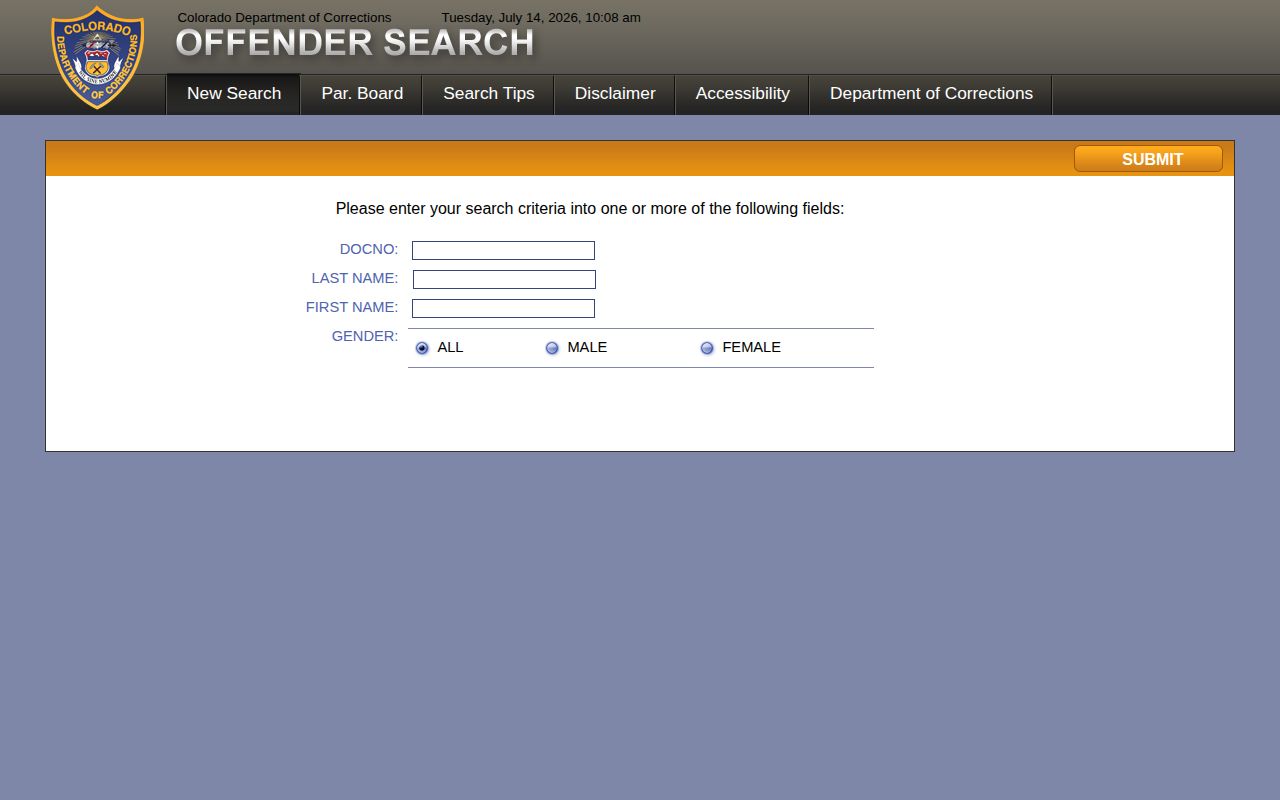
The screenshot fits this state-prison page because CDOC is the official public starting point for Colorado prison release, parole, and discharge status.
Colorado DOC Records Route
For public status, start with the offender search. For official time-computation or discharge records, use CDOC's open-records process and verify the current contact route directly with CDOC before relying on an email. The research found a historical source-code note referencing Time and Release operations at doc_open_records@state.co.us, but that note was removed from public display and should be treated as a lead, not a final active contact.
Colorado Department of Corrections
Offender search: https://www.doc.state.co.us/oss/
Parole calendar: CDOC parole-board calendar route
Public search fields: DOCNO, last name, first name, gender
Records note: verify current CDOC open-records route before sending time-calculation requests.
For the county case that sent the person to DOC, request the Gilpin Combined Court mittimus, disposition, or sentence order. C.R.S. section 18-1.3-405 requires presentence confinement credit to be found by the sentencing court and included in the mittimus, then deducted by DOC. That is why the court record and DOC record often need to be read together.
Colorado DOC Date Terms
Colorado prison release dates can change. A projected or tentative release date is not a promise. It can shift because of presentence confinement credit, earned time, parole-board action, mandatory-release calculations, disciplinary history, new cases, detainers, sentence modifications, or revocation. CDOC and court records should be used for the exact label and the current status.
- Parole eligibility date
- The point when parole consideration may be available under law and sentence rules.
- Mandatory release date
- A release-date concept used in Colorado parole reports and sentence-completion context.
- Sentence discharge
- The end of the sentence when the state records completion.
- Earned time
- Credit that may reduce time under Colorado statutes when certified progress criteria are met.
C.R.S. section 17-22.5-405 governs earned time. The research file notes up to ten days per month in general and up to twelve days per month for some lower-level felony categories when statutory conditions are met. Violent-offense and parole-eligibility rules can be more restrictive, so the current codified law and the individual sentence record control.
CDOC Is Not Gilpin Jail
A Gilpin County Jail release and a CDOC discharge are different events. Bond, time served in county jail, dismissal, or a probation sentence stays in the sheriff and court record trail. State-prison parole or discharge belongs to CDOC. If a county jail record says transfer to DOC, expect lag before the person appears in the state system because intake and record matching take time.
If the record says federal pickup, USMS hold, BOP custody, ICE hold, or immigration transfer, do not use CDOC as the answer. Use BOP for federal prison records from 1982 forward, federal court or USMS routing for pretrial federal custody, and ICE locator or facility contacts for immigration detention. For a release from Gilpin County Jail that remains local, use sheriff and court records first.
Note: CDOC release status confirms the state-prison track, not every possible local, federal, or immigration custody issue.
Colorado Parole Calendar
The CDOC offender-search system also links a public parole-board calendar route. The calendar is useful when the question is parole consideration or board schedule context, not physical county-jail release. The research source says the calendar displays monthly views and that hovering over a date pulls up that day's schedule, while clicking a calendar title opens a larger calendar.
Parole-board records should still be read with the offender profile and sentence record. Board rules describe parole application interviews, file reviews, full-board reviews, rescission, reconsideration before release, and notices of board action. A grant, defer, revocation, or rescission has a different meaning than a sentence discharge. When a Gilpin sentence has moved into CDOC, the court order explains the sentence and CDOC explains the prison/parole status.
Public Record Search
Sponsored Results