
Gilpin County Parole vs Probation
Parole and probation both involve rules after a person leaves jail or prison, but they come from different agencies. Probation is a court sentence. For Gilpin County cases, the 1st Judicial District Probation Department serves Jefferson and Gilpin Counties and is the local probation route for a person sentenced through the court. Parole is a state-prison release status. It is handled through the Colorado Department of Corrections and the Colorado State Board of Parole calendar, not through the local probation office.
A person can leave Gilpin County Jail on bond, time served, a probation sentence, a transfer to CDOC, or another agency hold. Only some of those paths create post-release supervision. The court disposition and sentence order are usually the best public records for a probation sentence. A state-prison case should be checked in the CDOC offender search, where parole, prison custody, discharge, or returned-to-custody status may appear for the right person.
| Route | What It Means | Primary Verification Path |
|---|---|---|
| Probation | Court supervision ordered instead of, or after, a jail sentence. | Gilpin Combined Court disposition, then 1st Judicial District Probation records. |
| Parole | State-prison release supervision under CDOC and the Parole Board. | CDOC offender search, parole calendar, and parole-board records where available. |
| Discharge | The sentence or supervision term has ended. | CDOC discharge status, court record, or custodian record response. |
- Parole
- Supervision after a Colorado state-prison release, controlled by CDOC and the State Board of Parole.
- Probation
- Court-ordered supervision in the community, handled for Gilpin County through the 1st Judicial District Probation Department.
- Absconder
- A supervision status that generally means the person is not reporting as required and may have a warrant or enforcement action.
- Discharge
- The end of a sentence or supervision term, documented by the agency that held the record.
Verify Gilpin County Supervision
Start with the release path. A person released from Gilpin County Jail to probation should have a court record that explains the sentence. A person released from a Colorado prison after a Gilpin conviction should be checked through CDOC and the parole system. If the person is still moving between custody systems, Colorado VINE through VINELink may help track custody-status changes, but it is an alert and status system rather than a complete supervision file.
- Confirm the court case. Use the Gilpin docket search for near-term hearing clues and case numbers.
- Request the sentence record when proof is needed. The Colorado Judicial Branch record/document request form can route requests for a disposition, sentence order, or register of action.
- For probation, contact the 1st Judicial District Probation Department or use the probation records email for record routing.
- For parole, search CDOC first by DOC number if known, then by name and gender, and compare identifiers before relying on a match.
- Use VINE for custody-change alerts when the person is still in jail or prison and the reporting agency feeds the system.
For a broader released-person lookup, the Gilpin County released inmates hub separates county jail, court, DOC, VINE, federal, and ICE paths. That distinction matters because a local release may mean a community release, a probation sentence, a transfer to state prison, or a transfer to another agency.
Note: Name-only matches can be wrong, so compare case number, DOC number, date of birth, and reporting agency when those fields are available.
Gilpin County Probation Office
The Gilpin County probation page says the 1st Judicial District Probation Department serves Jefferson and Gilpin Counties. It lists the Remington Building in Lakewood for Juvenile, DUI & Investigation and gives separate contacts for general probation questions and probation record requests. This is the probation route for a Gilpin County court sentence, not the parole route for a state-prison release.
1st Judicial District Probation Department
Remington Building
11011 W. 6th Avenue, Suite 320
Lakewood, CO 80215
Phone: 720-772-2300
Fax: 720-685-6501
General email: 01probation@judicial.state.co.us
Records email: 01ProbationRecords@judicial.state.co.us
The same public page also names the First Judicial District context, which is why Gilpin probation questions often point outside the county line to Lakewood or Jefferson County court infrastructure. Do not treat that as a CDOC parole contact. If the record says parole, use CDOC and the Colorado State Board of Parole instead.
The screenshot below comes from the official Gilpin probation source for this contact route.
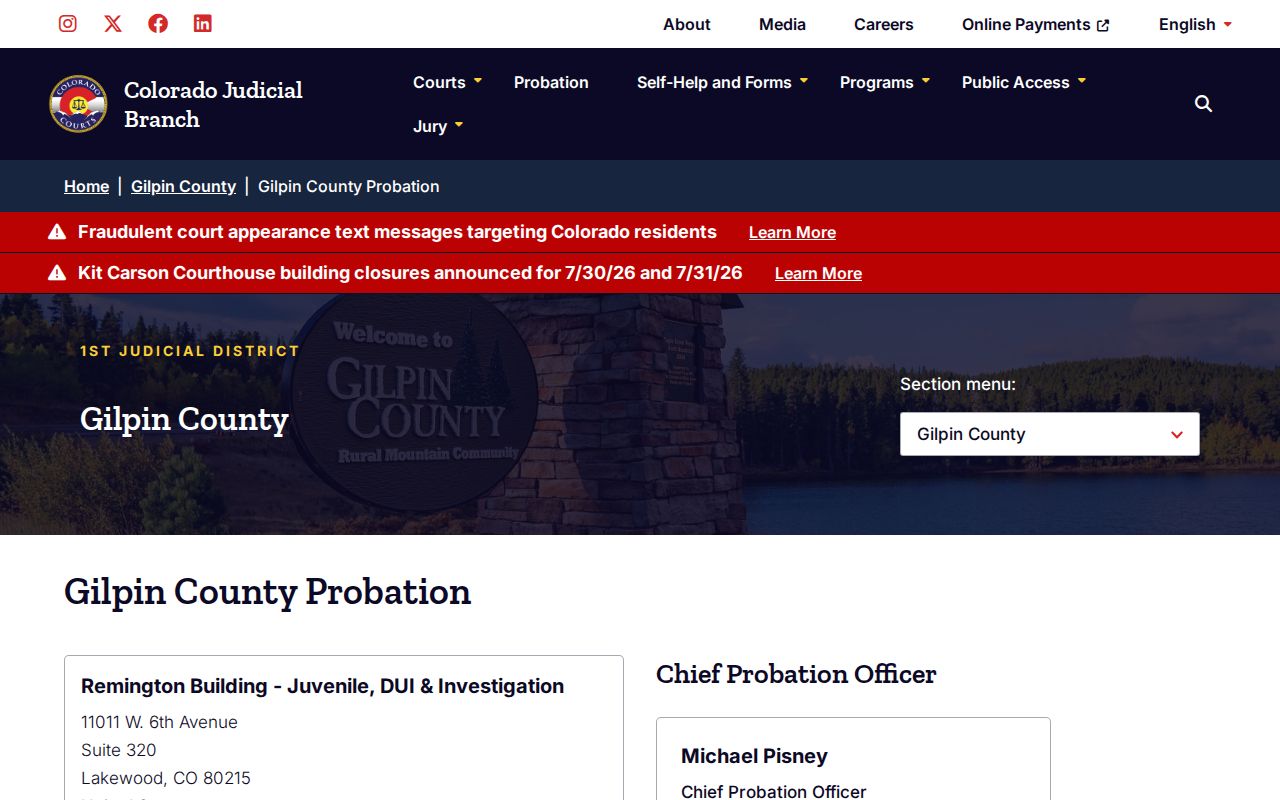
Use that source for the probation department and records email, then use the court record for the public sentence document that created supervision.
Gilpin County Parole Calendar
Parole is tied to state prison, not local probation. The Colorado State Board of Parole handles discretionary parole releases and parole-related actions under state law and rules. CDOC hosts the public parole-board schedule at doc.state.co.us/oss/index.php?ref=pblist. The calendar route shows monthly calendars and says a user can hover over a date for that day's schedule or click a calendar title for a larger view.
The parole-board route is useful when a Gilpin County conviction led to a state-prison sentence. A county jail release may have been a transfer to CDOC, with the later release controlled by parole eligibility, board action, mandatory release, or sentence discharge. A parole hearing calendar is not a complete person lookup, so it should be paired with the CDOC offender profile and any official record request needed for a specific parole action.
The screenshot source for this route is the CDOC parole-board calendar page.
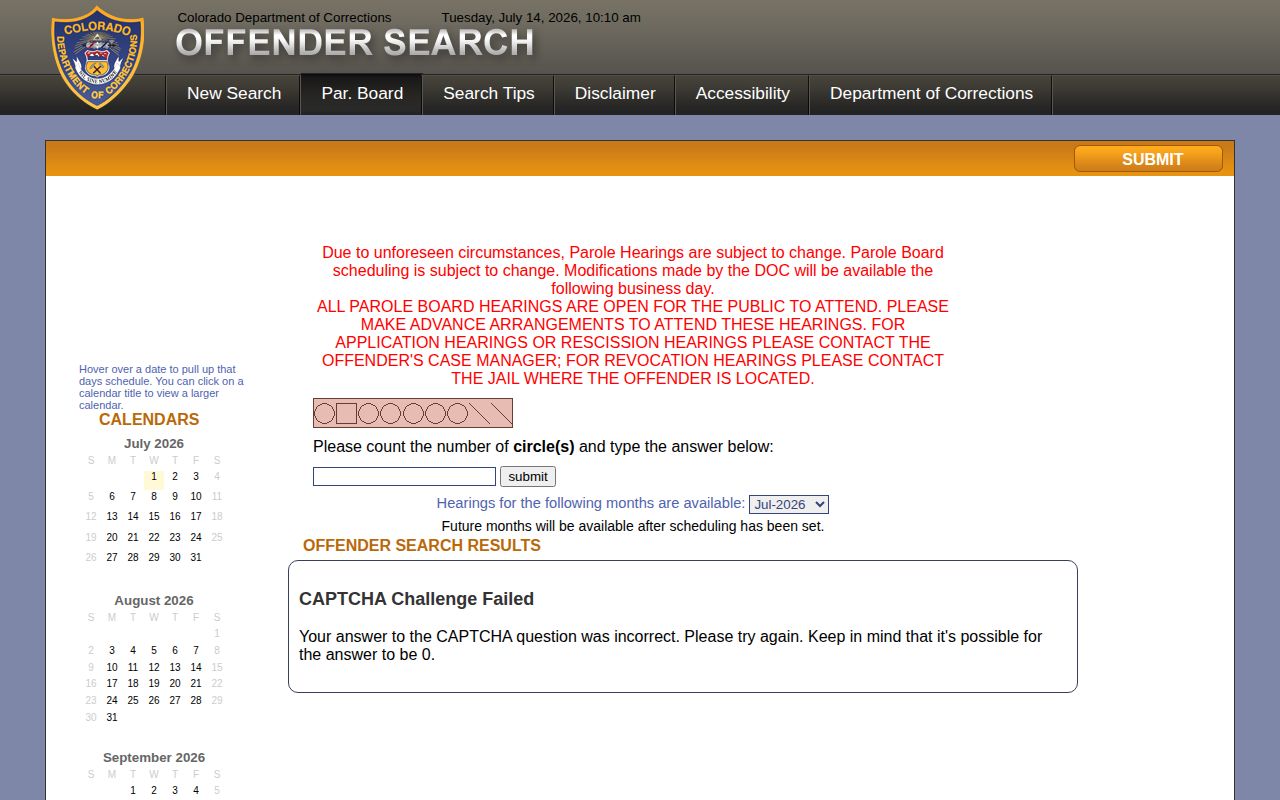
The calendar helps place a state-prison release in the parole-board process, while CDOC search results and board records carry the person-specific status.
Gilpin County Absconder Checks
Supervision conditions are rules imposed by the court, CDOC, or parole board. Public pages should describe them at a high level only. Common categories include reporting, residence approval, treatment, court-ordered payments, no-contact terms, testing, and new-law-violation rules. The exact terms depend on the sentence, parole action, and written order. Public users should not expect a probation or parole office to disclose private case-management details by phone.
Absconder or warrant status can change the release picture. A person may have left jail but later failed to report, violated a condition, or been returned to custody. The Gilpin probation page contains a local warrant-resolution history through First Judicial District Fresh Start events for certain Jefferson or Gilpin cases, including non-violent, non-VRA, low-level misdemeanors, traffic charges, and some probation felonies. The cited events are historical and include outdated event references, so no current Fresh Start event should be assumed from that page alone.
When warrant or absconder status is the question, use official channels: the court docket for hearings, the court record request form for orders, CDOC for parole status, VINE for custody changes, and probation records routing for probation-related records. A social post or old third-party listing should not be treated as proof that supervision is active or inactive.
Gilpin Supervision Record Corrections
ID, property, and correction issues should go to the custodian that created the record. For jail release records, booking sheets, or booking photographs, the Gilpin sheriff records route is the local custodian. For court case errors, use Gilpin Combined Court or the Colorado Judicial Branch record request process. For probation supervision records, use the 1st Judicial District Probation Department records email. For state-prison parole and discharge status, use CDOC and parole-board channels.
Colorado criminal-justice records are governed by the Colorado Criminal Justice Records Act. The Colorado Attorney General summarizes that records of official actions must be available for inspection, while other criminal justice records may be open subject to custodian discretion. The CBI CCJRA page also states that records should be requested from the agency or custodian that holds them.
That custodian split is the safest way to fix errors. A jail cannot correct a CDOC parole field. Probation cannot rewrite a court disposition. CDOC cannot supply a county booking sheet. Send a narrow request that names the person, case or booking number if known, date range, and the exact record being questioned.
Gilpin County Supervision Discharge
Supervision ends through a discharge, termination, revocation, sentence completion, or other official action. For probation, the court and probation department are the key sources. For parole, CDOC and the Colorado State Board of Parole are the public starting points. A person may be released from physical custody but still under rules, or the person may have completed the term and discharged from supervision. Those outcomes should not be guessed from the absence of a jail roster entry.
Colorado records law also creates limits. Sealed, suppressed, juvenile, protected, or confidential material may be restricted or redacted. The court record request form warns that some files or parts of files may require additional authority or identification. CDOC and sheriff records can have their own custodian review. Absence from a public website is not proof that no supervision record exists.
For a clean final check, match the case path to the custodian: Gilpin Combined Court for the order, probation records for court supervision routing, CDOC for parole or prison discharge status, VINE for recent custody changes, and sheriff records for the local jail release record. That chain keeps Gilpin County post-release supervision tied to official sources rather than assumptions.