
Gilpin Court Release Records
Gilpin Combined Court is part of the Colorado Judicial Branch, 1st Judicial District. It does not operate the jail and does not process the physical walkout from custody. Its value is different: the court record often survives after a person has dropped from any current jail view. A docket entry can show a hearing, case number, courtroom, and appearance type. A record request can produce the disposition or sentence order that explains the custody result.
For a released Gilpin County Jail detainee, the court file can show whether release followed a bond order, personal recognizance bond, dismissal, sentence to time served, sentence to probation, mittimus to Colorado DOC, or other order. A jail release sheet and court register of action answer related but different questions. The sheriff record tells what the jail did. The court record tells what the judge or clerk recorded in the case.
| Court record | Release question it can answer |
|---|---|
| Docket entry | Which hearing may have led to release or transfer |
| Disposition or sentence order | Whether the case ended, continued, or produced a sentence |
| Mittimus | Whether the person was committed to DOC or credited for presentence confinement |
| Register of action | Case events, charges, minute orders, and sentence notes in one record trail |
Confirm Gilpin Court Outcome
The public docket is the near-term check. It is not a release list, and it should not be read as proof that a person walked out of jail. It can, however, identify the case number and hearing type needed to request a durable document. For a named person search, pair the docket with the sheriff release route described on the Gilpin County released inmates hub.
- Open the Gilpin County docket search and use at least one filter in addition to date.
- Match the party name, case number, hearing type, location, appearance type, and courtroom before drawing a conclusion.
- Use the Colorado Judicial Branch record/document request form to ask for the disposition/sentence order or register of action.
- If the order points to probation, use the 1st Judicial District Probation route. If it points to DOC, use the CDOC offender search after transfer and intake.
The Gilpin County court landing page is the source for the court address, docket links, and records path shown below.
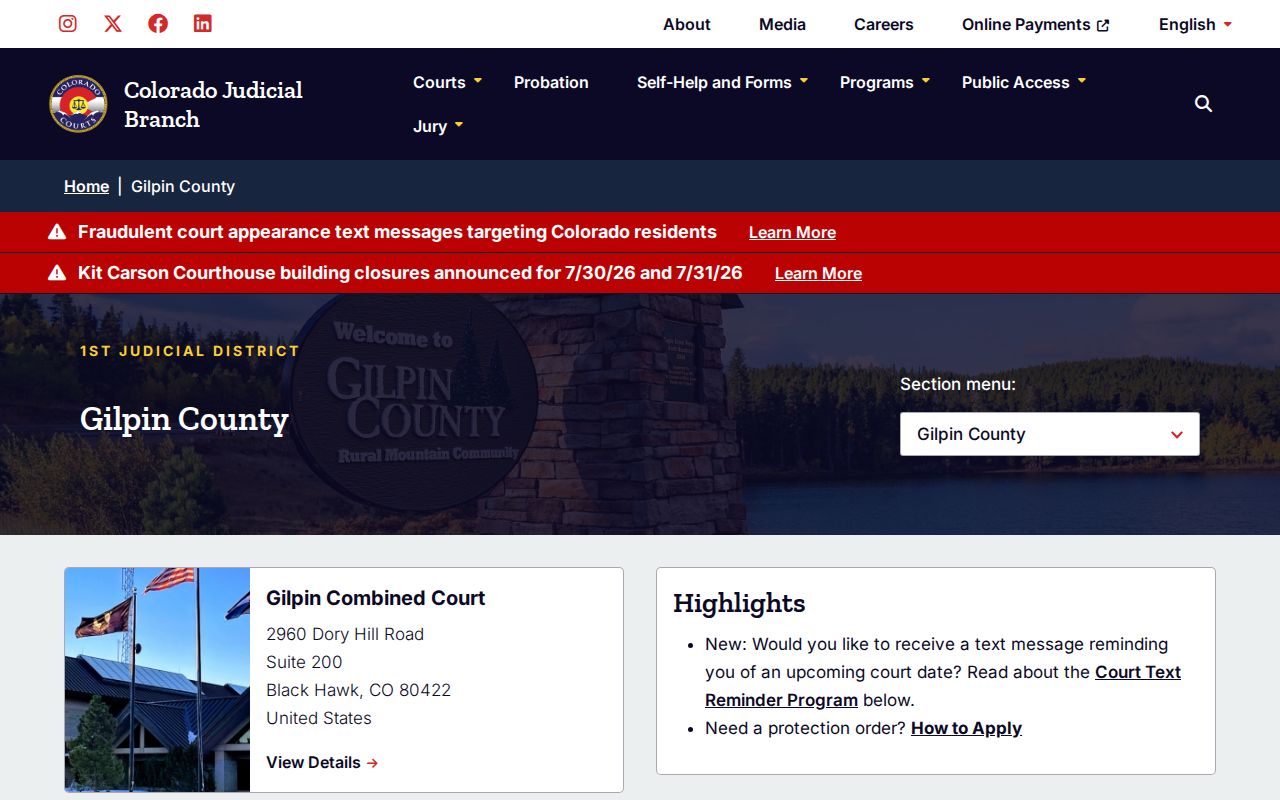
The court source connects the local courthouse, docket, and record request route that explain many jail release outcomes.
Gilpin Court Contact
Use the clerk and court record request process for court documents. Do not send jail booking-photo or jail release-sheet requests to the court. The court is the custodian for case files, docket entries, disposition and sentence orders, registers of action, and related court documents. Some files or document parts can be restricted, suppressed, sealed, or protected under law or court order.
Gilpin Combined Court
2960 Dory Hill Road, Suite 200
Black Hawk, CO 80422
Phone: 303-582-5522
Fax: 720-894-8659
Email: GilpinClerksOffice@judicial.state.co.us
Clerk hours: Monday-Friday, 9 a.m. to 4 p.m.
Dockets begin: 8:30 a.m.
The record/document request form says responses are generally provided within three business days unless there are extenuating circumstances. Fee estimates include copy fees, certified or exemplified copy fees, name search fees, off-site retrieval at actual cost, and research or redaction charges after the first hour.
Gilpin Records Fee Route
Court documents are requested through the statewide Judicial Branch form, not through a jail release feed. In a criminal matter, the request options include complaint or information, disposition or sentence order, protection order, ticket, and register of action. The register of action is often the most useful first document because it can summarize charges, sentence entries, and minute orders.
| Item | Fee estimate |
|---|---|
| Copy per page | $0.25 |
| Certified or exemplified copy | $20 per document |
| Name search | $5 |
| Transcript of judgment | $25 |
| Research or redaction after first hour | $30 per hour in 15-minute increments |
Note: A court event can explain release, but the sheriff remains the custodian for jail booking and release sheets.
Gilpin Custodian Split
Gilpin's court, sheriff, and jail records converge around the Dory Hill Road justice-center location, but they do not have one custodian. Gilpin Combined Court is listed at Suite 200. The sheriff administrative-services contact is listed at Suite 300. A person seeking release proof may need both offices: a sheriff release sheet for the custody event and a court register of action for the legal reason.
This split also helps avoid a common mistake. A court sentence to probation does not make the person a parolee. A court mittimus to DOC does not mean the person was released from all custody. A dismissal or bond order may explain why the jail hold ended, while the case may still have future hearings or conditions.
Gilpin Court Access Limits
Colorado court access is not all-or-nothing. The Judicial Branch record request form says the clerk can restrict access to files or parts of files under statutes, rules, Supreme Court directives, local orders, and other legal authorities. Suppressed cases, juvenile matters, probate records, and documents with confidential or protected information may require identification or may not be released in full.
That limit is important for release confirmation. If a public docket does not show the expected detail, it does not prove the release event never happened. It may mean the record is sealed, suppressed, delayed, filed under a different case number, or held by another custodian. The next step is a specific request for the register of action, disposition or sentence order, or mittimus, plus a separate sheriff records request when the custody sheet itself is needed.
Public Record Search
Sponsored Results