
Parole After Gilpin Prison Sentences
A Gilpin County defendant who receives a Colorado prison sentence moves out of county jail tracking and into CDOC custody. The later release may be a parole release, not a jail release. The Colorado State Board of Parole decides discretionary parole releases and parole-related actions under state law and rules, while CDOC hosts the public offender search and parole-board calendar route.
The distinction is important. A person can be released from the Gilpin County Jail to CDOC and remain in custody. Years later, the same person may be paroled from a Colorado prison. The county jail release sheet explains the transfer from Gilpin custody. The CDOC offender profile, parole-board calendar, and board records explain the later prison release and supervision status.
Check Colorado Parole Status
Use CDOC and parole-board sources for state-prison release questions. Do not use the Gilpin County Jail as the main source for a parole hearing or prison discharge date. The county court record may still matter because it identifies the conviction and sentence that led to CDOC custody.
- Search the CDOC offender search by DOC number when known, or by name fields when a number is not known.
- Look for the exact status wording, such as paroled, discharged, absconder, returned, or other CDOC label.
- Use the CDOC parole-board calendar route for hearing schedule context.
- Check Gilpin Combined Court records for the sentence order or mittimus if the prison sentence source is unclear.
- Use official records requests when a board action notice, time-computation record, or court document is needed.
The CDOC parole-board calendar source is shown below from the project manifest.
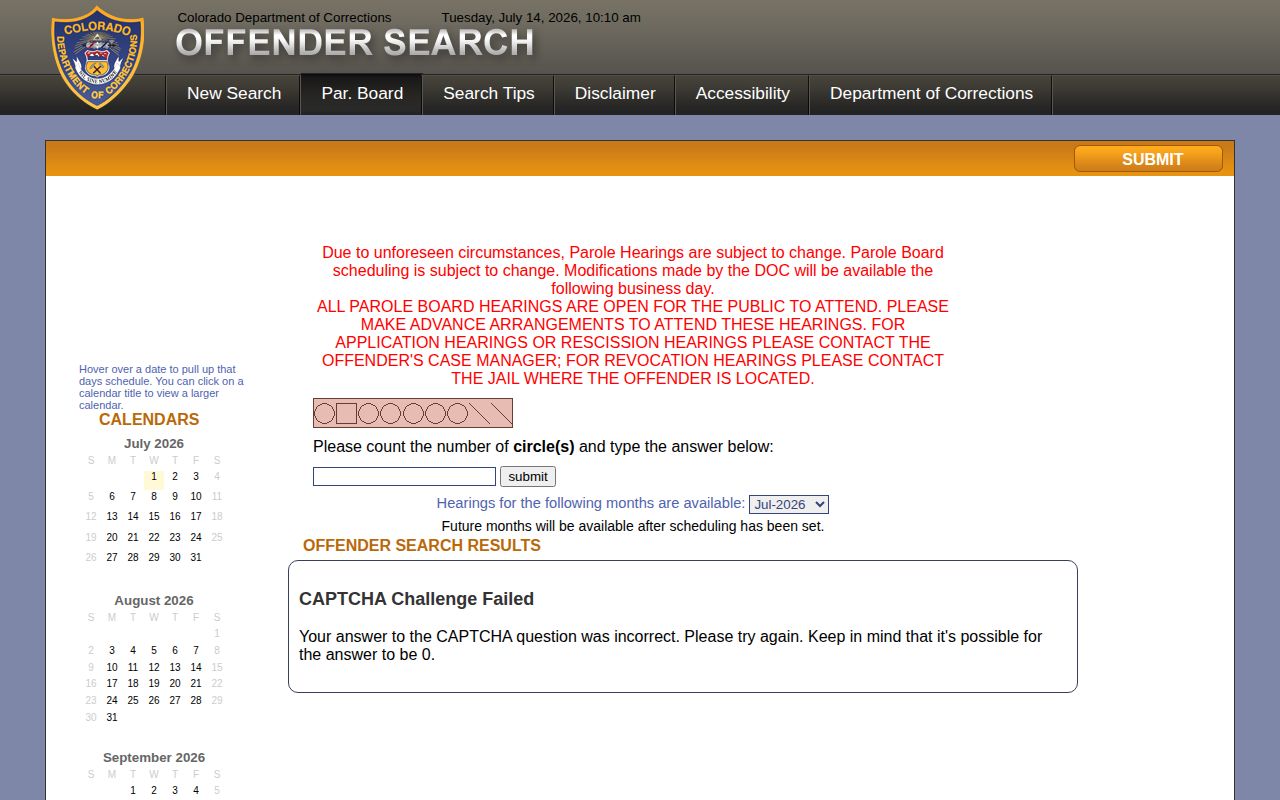
The calendar is useful for timing and hearing context, but a calendar listing alone is not the final release record.
Colorado Parole Decision Types
Colorado parole-board rules describe several decision and review paths. A parole application interview considers an eligible inmate's application and can set destination, duration, and conditions if parole is granted. The rules also address file reviews, full-board reviews, rescission or reconsideration before release, and notices of board action.
| Board action | Release-search meaning |
|---|---|
| Grant parole | The board authorizes parole, subject to conditions and final release processing. |
| Defer consideration | Release is not granted at that review, and a later review may be set. |
| Full-board review | A broader board review applies under rule procedures. |
| Rescission or reconsideration | A granted release can be reconsidered before physical release if new issues arise. |
| Revocation context | A person on parole may be returned or face board action after a violation. |
Parole Eligibility Dates
Colorado parole reports and statutes use terms such as parole eligibility date, mandatory release date, and sentence discharge date. A parole eligibility date is not the same thing as actual release. A person may be eligible for review but still remain in custody after a deferment or other board action. A mandatory release or sentence discharge term can have a separate meaning under Colorado sentencing law.
The research identifies C.R.S. 17-22.5-403 for parole eligibility, C.R.S. 17-22.5-405 for earned time, and C.R.S. 18-1.3-405 for presentence confinement credit. Those rules matter for a Gilpin County defendant sentenced to DOC because local jail time and later earned time can affect the state-prison timeline.
Note: A projected parole event can change because of board action, discipline, detainers, sentence corrections, or transfer timing.
Parole Board Records Route
For public lookup, start with CDOC offender search and the CDOC-hosted parole-board calendar. For an individual board action notice or official parole record, use official records channels rather than asking a county jail for state-prison parole details. The county court can provide sentence documents that explain why the person entered CDOC custody.
Offender search: CDOC offender search
Parole calendar: CDOC parole-board calendar
Local sentence records: Gilpin County court page
Jail Release vs Parole
A Gilpin County Jail release and a Colorado parole release are not the same event. The jail release may be bond, time served, probation, dismissal, transfer, or pickup by another agency. Parole is tied to state-prison custody after a prison sentence. If a Gilpin case results in a probation sentence, use the 1st Judicial District Probation route rather than parole-board records.
For a person whose records cross systems, build the timeline in order: Gilpin sheriff release sheet, Gilpin Combined Court sentence or mittimus, CDOC offender profile, parole-board calendar or action, and VINE notification if a custody alert is needed. That order prevents a county jail transfer from being mistaken for a final prison release.
The parole-board calendar is not a recent-release feed. The research says it displays monthly calendars and allows users to view schedule details, but the public annual decision reports summarize board activity rather than serving as a one-person release lookup. For one person, the practical public sources are the CDOC offender profile, the calendar for hearing context, the court sentence record, and official records requests when a board action notice is needed.
Parole can also change after a decision. The board rules describe rescission or reconsideration before release when new information or conduct issues arise. That is why a projected parole date, a hearing date, or a grant decision should be confirmed against the final custody-status record before treating the person as released from prison custody.
Public Record Search
Sponsored Results